Showing posts with label Brief 5 | Context. Show all posts

Monday, 1 April 2013

FMP | Tiffany & Co. Packaging


Whilst developing the initial designs for the branding and packaging for the La Petite Macaron brief, I was a little concerned that my spearmint green and white colour scheme may look a little similar to the famed Tiffany & Co. jewellery box packaging (and, despite it being beautiful, I, of course, would like my packaging to be original). 

However, upon looking at the site and the packaging in further detail, I feel confident that what are described as 'Blue boxes' are far enough from my own spearmint colour palette. Time to get the ball rolling.

FMP | Macaron Packaging


Bonnard | Anagrama

-

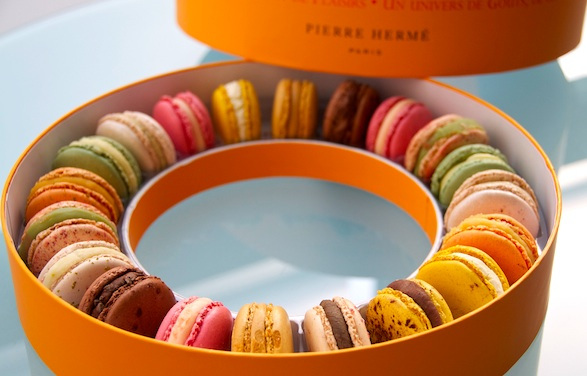
Developing my research for the La Petite Macaron brief, I decided to research existing macaron packaging used  commercially, on a large, or to an even global scale, as well as more boutique one-off products packaging designs.

I found a great selection online, some with really soft, pastel colours, and others, such as the brief from Bonnard by Anagrama, using a minimal, white base and then exploring the use of bold and bright colours in inventive and innovative ways through paint daubs and sprayed textures to create a really unique and individual design outcome.

For the product, the colour scheme and aesthetic of the packaging will be just as important as the structural design, housing such a delicate product that should be enhanced in terms of it's colour, petite scale and textures, visually communicating the character of the macaron itself. 

I particularly like the use of pastel tones and colour palette throughout the designs to reflect the food colouring in the vivid, colourful macarons themselves, as well as, in the last two images, how the macarons are compartmentalised... ensuring that each macaron remains intact and can be an individual treat, as well as a collective one (if you can't resist having more than one at a time!).

I look forward to exploring this packaging brief in more detail and really testing my ability to work with applied branding design.

-


Paulette Macarons


Laduree Packaging


Bottega Louie Packaging
www.bottegalouie.com


Beyaz Firin Macarons | Karbon


Macaron Packaging | Pierre Hermé


Wholesale Cake Boxes | DHgate.com


Sunday, 31 March 2013

FMP | Spotted Jersey


Researching more into polka dot patterns, and the history and culture of polka dots in France, I knew that one of the most visually significant use of polka dots is within the Tour de France annual bicycle race. Throughout the course, four coloured/patterned jerseys are distributed to racers for particular achievements and accolades.  

The polka dot jersey, maillot à pois rouges, represents the 'King of the Mountains'. Points are awarded to the first rider to reach the crest of designated hills and mountains, all of which being individually graded according to steepness, length, position on the course, and points correspond to these grades. Despite the best climber award starting in 1933, the jersey was not worn until 1975.


FMP | Polka Dot Fashion


As part of the La Petite Macron brief, and considering a design direction and application of polka dots into the design, I felt it was important to look at all aspects of polka dot application, and, in particular, fashion.

Since the 1950's polka dots have had a prominence within all sub categories and genres of fashion, be it rockabilly, romantic, preppy, or a classic vintage style. Much like their simple, yet effective fashion contrast, stripes, polka dots are the style and pattern that never seem to go out of fashion, and always maintain a charm, femininity and playfulness, as shown from some of the high street and high end fashion shown throughout the images sourced above and below from the site LookBook (link above).

Although I still feel the need to look further, culturally, and from a design perspective at the polka dot, as well as applying some designs myself, I'm anticipating some really positive and charming results which will wonderfully suit and visually communicate both the quality and the character of the brand and the product, as well as, geometrically, of course, having visually connotations and connections to the macaron products themselves.


FMP | Polka Dots


-

Throughout the consideration and early stages of design development for the La Petite Macaron brief, I had an early concept to work the same, traditionally circular shape of a macaron into the 'Macaron' element of the logo. Although this felt a little too gimicky, I thought that it could potentially be incorporated into the design itself.

Although stripes are perhaps more quintessentially French (thanks to the riviera and, of course, Jean Paul Gaultier), this could be quite an interesting design direction and pattern application to explore, and would certainly suit the elegant yet playful, high end design aesthetic I hope to achieve in my design outcomes.

Shown above and below are some researched images of simple polka dot patterns, with varying sizes, and with some colour palettes dark on light, with others reversed out.

I look forward to both experimenting with the design process in further detail, as well as researching the history/application of polka dots to establish whether culturally, and from a design perspective, it would be a truly appropriate route to follow. 

-


www.pomegranateseedshome.com


FMP | Nigella Lawson Website


www.nigella.com

For me, Nigella Lawson's cookery website is a great example of the aesthetic I hope to achieve throughout my La Petite Macaron brief. Despite having a colourful, playful colour palette and vector-based type / logo marks used throughout, there is a clear grid structure to both the website itself and the use of type and colour in balance, as well as wonderful consideration for high resolution photographic images, which really sell the products, or in this scenario, Nigella's cooking, to the public.

A really fun, feminine and elegant site. I will potentially look to create something slightly more corporate to suit the visual aesthetic and to cater for the Central Parisian audience, but whilst developing initial designs, this source of contextual research will certainly be a consideration.


FMP | La Petit Maracon Location


Despite being a proposed, and hypothetical brief (as well as product and company itself), I hope to make the 'La Petit Macaron' outcomes as professional, and, importantly, believable as possible, to demonstrate how effectively they would work in a real life context. Therefore, I decided to research a suitable proposed location for the boutique patisserie that would adhere to the brief target audience of high end working professionals, and, in particular, targeting the products at women. 

Although I am familiar with Paris to an extent (I spent a significant amount of time in France as a child), I knew it was important to do my research, and when searching for the finest bakeries in Paris, Avenue Bosquet was highlighted, along with housing the acclaimed restuarant, Le Bosquet, so, naturally, I feel this would be a perfect proposed location for the working professional, just a stone throws away from the Eiffel Tower on the main streets, with other cuisine options and businesses within close proximity.

The proposed address is as follows:

88 Avenue Bosquet
75007 Paris
Île-de-France
France

Which will be incorporated into branded stationary and packaging designs.


FMP | History of the Macaron


-

A brief history and introduction to the macaron, as part of my Design Context and research development for the La Petit Macaron brief which I have begun as a replacement brief (but hopefully far greater an outcome as a result of it) for the past proposed Shrewsbury Flower Show rebranding brief.

All information sourced from the relevant Wikipedia page.

-

MACARON


A macaron is a sweet meringue-based confectionery made with eggs, icing sugar, granulated sugar, almond powder or ground almond, and food colouring. It is also caled Luxemburgerli. The macaron is commonly filled with ganache, buttercream or jam filling sandwiched between two cookies. The name is derived from the Italian word maccarone ormaccherone.
The confectionery is characterised by smooth, squared top, ruffled circumference (referred to as the "foot" or "pied"), and flat base. It is mildly moist and easily melts in the mouth. Macarons can be found in a wide variety of flavors that range from the traditional (raspberry, chocolate) to the new (foie gras, matcha). The fillings can range from jams to ganache to butter.
Since the English word macaroon can also refer to the macaroon, many have adopted the French spelling of macaron to distinguish the two items in the English language. However, this has caused confusion over the correct spelling. Some recipes exclude the use of macaroon to refer to this French confection while others think that they are synonymous.

HISTORY

Although predominantly a French confection, there has been much debate about origins. Larousse Gastronomique cites the macaron as being created in 1791 in a convent near Cormery. Some have traced its French debut back to the arrival of Catherine de' Medici's Italian pastry chefs whom she brought with her in 1533 upon marrying Henry II of France.
In the 1830s, macarons were served two-by-two with the addition of jams, liqueurs, and spices. The macaron as it is known today, composed of two almond meringue discs filled with a layer of buttercream, jam, or ganache filling, was originally called the "Gerbet" or the "Paris macaron." Pierre Desfontaines of the French pâtisserie Ladurée has sometimes been credited with its creation in the early part of the 20th Century, but another baker, Claude Gerbet, also claims to have invented it.

VARIATIONS

French regional variations


Several French cities and regions claim long histories and variations, notably Lorraine (Nancy and Boulay), Basque Country (Saint-Jean-de-Luz),Saint-Emilion, Amiens, Montmorillon, Le Dorat, Sault, Chartres, Cormery Joyeuse and Sainte-Croix in Burgundy.
Macarons d'Amiens, made in Amiens, are small, round-shaped biscuit-type macaroons made from almond paste, fruit and honey, which were first recorded in 1855.
The city of Montmorillon is well known for its macarons and has a museum dedicated to it. The Maison Rannou-Métivier is the oldest macaron bakery in Montmorillon, dating back to 1920. The traditional recipe for Montmorillon macarons remains unchanged for over 150 years.
The town of Nancy in the Lorraine region has a storied history with the macaron. It is said that the abbess of Remiremont founded an order of nuns called the "Dames du Saint-Sacrement" with strict dietary rules prohibiting the consumption of meat. Two nuns, Sisters Marguerite and Marie-Elisabeth are credited with creating the Nancy macaron to fit their dietary requirements. They became known as the 'Macaron Sisters' (Les Soeurs Macarons). In 1952, the city of Nancy honored them by giving their name to the Rue de la Hache, where the macaron was invented.

Switzerland

In Switzerland the Luxemburgerli (also Luxembourger) is a bit smaller as a French macaron, and it is said to be lighter and more airy in consistency.

Japan

Macarons in Japan are a popular confection known as "makaron". There is also a version of the same name which substitutes peanut flour for almond and is flavored in wagashi style, widely available in Japan.

Korea

Macarons are popular in South Korea, pronounced as "ma-ka-rong" in Korean. To add a rather Asian flavor, green tea powder or leaves are used to make green tea macarons.

POPULARITY

In Paris, the Ladurée chain of pastry shops has been known for its macarons for about 150 years. In France, McDonald's sells macarons in their McCafés (sometimes using advertising that likens the shape of a macaron to that of a hamburger). McCafé macarons are produced by Château Blanc, which, like Ladurée, is a subsidiary of Groupe Holder, though they do not use the same macaron recipe.
Outside of Europe, the French-style macaron can be found in Canada and the United States.
In Australia, Adriano Zumbo along with the TV series MasterChef have seen the macaron become a popular sweet treat, and it is now sold by McDonald's in its McCafe outlets.

SAMPLE RECIPE

  • 2/3 cup almond meal or ground almonds
  • 1 1/2 cups powdered sugar
  • 3 large egg whites at room temperature and preferably aged up to 3 days
  • 5 tablespoons granulated sugar
  • 1 teaspoon vanilla extract

FMP | La Petit Macaron Brief


After deciding to abandon the Shrewsbury Flower Show project, today I brainstormed ideas for a new project to take it's place.

Even since January, I feel that my tastes and design direction has evolved, and along with extensive research for my Design Context brief, I have developed a much more considered taste in design.

As a result, I knew I wanted to work with both branding and packaging, and preferably within the food industry. I also knew I wanted to create a project to demonstrate my interest in both high end print spec, along with travel.

Putting all these elements together, I have proposed the brief of 'La Petit Macaron', details of which are shown in more detail in the brief above, but, in summary, will allow me the opportunity to brand, and create the promotional packaging for, a hypothetical Parisian boutique Macaron Patisserie. I'm really excited to get started, and it feels great to be really passionate about a brief again. Really looking forward to getting the ball rolling.